How to set up a scavenger hunt at a kid's birthday party
Published 2026-10-16 · Updated 2026-10-16
Hide the cards before the guests arrive. At a kid's birthday party, run the scavenger hunt as one activity: two teams if you have a group, a short chain of cards, and a prize every child can reach. Hand out only the first card. A children's treasure hunt is the same game. Each card names one next place. The last place holds the prize.
The Goosechase birthday list is a digital Mission list for each month, including January photos of icicles and December photos of holiday lights, played on a smartphone. The ideas below are paper hunts you hide at home.
Birthday party hunt ideas
- Gift trail for the birthday child. Hide the cards before they walk in. The last stop is the present, or a note that sits with the present. The iMOM birthday hunt is eight steps, including the starting clue and the final Happy Birthday note. The printable names these answers: pillow or bed, dishwasher, under the dining room chair, toothbrush, piggy bank, shoes, and microwave or oven.
- Two-team race. Write two copies of each card so the teams are not pulling one card from the same spot. Both copies name the same next place.
- Split trail. Team A and team B get different first cards. Both last cards name the same finish, so the teams meet at the prize.
- Favor stops. A small favor waits at each stop, one per guest if you have enough stops. The birthday surprise waits at the last stop.
- Picture find-list in the party room. Draw the things you want found. A child who is not reading yet matches the picture. You hold the list and check items off. Stay in that room.
- Color and shape list. In that same room, find something red, something soft, and something that opens. Call each find out loud so the group stays together.
- Rhyme chain through rooms the child knows. One place per card. Lines by room and by reading level are on scavenger hunt clues.
- Yard finish. The last card names a tree or the porch if you have one. A nature find-list, a yard clue trail, and a neighborhood route are on outdoor scavenger hunt for kids.
- Cake-table finish. The last card names the table where a note and a snack wait, so the hunt ends where the party continues.
- Word list for guests who already read. They find things you named in words. Use pictures for guests who are still learning letters.
This page is a kids' party at home. It is not an adult phone hunt, and it is not a plan for a ten-year-old who wants a long puzzle. A child who already reads can take a longer rhyme chain from the clues page.
The four setup pieces
| Piece | What to do |
|---|---|
| Teams | Two teams when you have a group. One hunter when it is only the birthday child, before friends arrive. |
| Hiding order | Write the chain backward from the prize. Hide every card before anyone arrives. Keep a copy of the order in your pocket. |
| Timing | One activity inside the party, not the whole party. Keep each stop short. Drop a few cards if the group is young. |
| Prize | Something every child on a team can have. A single present fits a hunt for the birthday child alone. |
How to split teams
By 5 years, most children follow rules or take turns when playing games with other children, on the CDC milestones by 5 years. Two teams can share one hunt if the rule is simple: one card, then the other team goes, or each team has its own copy of the cards.
Count the guests. An even group splits in half. An extra guest joins the birthday child's team. A party of one child is the gift trail, not a race.
The iMOM printable has no team split and no minute count (iMOM printable). It fits the gift trail for one child. A group needs the split above.
Hiding order before guests arrive
By 4 years, most children (75% or more) can say sentences with four or more words and can tell what comes next in a well-known story, on the CDC milestones by 4 years. A card that names the next place matches that shape. You read the card if the child is not reading yet, and a picture of the place sits beside the words.
- Pick one idea from the list above.
- List only places you have.
- Put the prize at the last place.
- Write the card that names the last place, and hide that card at the place before it.
- Keep going backward until the first card, which you hand out.
- For a split trail, build the chain twice. Both last cards name the same prize.
- Write the order on a sheet you keep in a pocket, so you can help and leave the next card hidden.
- Hide every card before the first guest arrives. Walk the trail once and move any card that names a place you do not have.
The limit of this setup is the house you have. A missing couch, towel bar, or yard means you rewrite the one card that named it, and you walk the trail once before the first guest arrives. Two teams on one set of cards will bunch up unless you hide a second copy or start the second team after the first has moved on.
Timing inside the party
Paying attention for 5 to 10 minutes during activities, such as story time or making arts and crafts, is on the CDC milestones by 5 years. Plan each stop as one short activity of that kind: read one card, go to one place, find the next card. The party around the hunt is a separate block. After the prize, move to another game. A running order for the rest of the party is on kids' birthday party games.
The Goosechase birthday list has no minute count for a paper trail (Goosechase birthday list). On the iMOM birthday hunt, if the hunt is for a little one, leave a few clues out to make the hunt shorter, and it will still work.
A packaged party hunt on the Think Tank Puzzles page has kids read 14 riddles in the first of two rounds, then move on a treasure map. That length is a whole activity by itself. A home birthday can stay with a short chain.
The prize at the end
The Think Tank Puzzles page says the final prize is up to you: prizes for all the party-goers, or just a grand prize. For a group, give every child the same small thing, so the second team is not empty-handed. A snack, a handwritten note, or the same small favor works. For the birthday child alone, the present is the prize.
Put the prize where the next moment happens, usually the table with the cake, so the hunt ends and the party continues in the same spot.
One party afternoon (illustrative)
Eight guests, two teams of four, six stops. Team A starts at the front door. The door card names the couch. The couch card names the sink. The sink card names the kitchen table. Team B starts at the towel. The towel card names the pillow. The pillow card names the kitchen table. A note and a snack for each child wait on that table. You hid both trails before the doorbell. You walked each trail once. If the home has no couch, Team A's door card names the sink instead, and the sink card still names the table.
A hunt already set for two teams
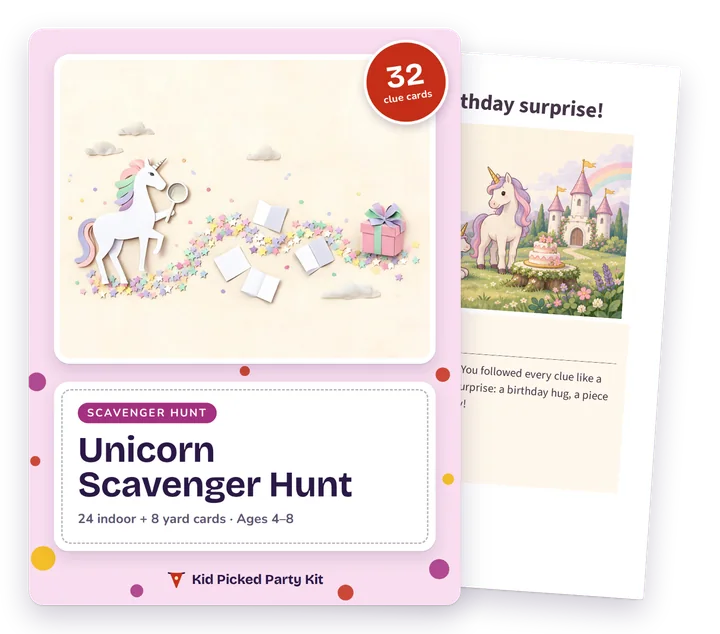
The Unicorn Birthday Scavenger Hunt runs a unicorn treasure hunt at home or in the yard that ends at a surprise, for a birthday child or a party group. It holds 24 indoor and 8 yard riddle cards with picture hints and parent stubs, start and finish letters, a hiding-order sheet and blank cards, and a Party Maker file: pick your places, edit any riddle, add the child's name. It lets you untick places you do not have and edit riddles, and add the child's name in the Party Maker, or use the PDFs and the hiding-order sheet by pen. It also includes team mode for two teams. It requires a printer, paper, scissors and a small prize, plus a web browser to pick places. It comes as US Letter and A4 PDFs, in separate files. It is print-only. It is written for ages 4–8, and non-readers need a reading buddy.
Questions
What is a scavenger hunt game?
A scavenger hunt game is a short trail of cards. Each card names the next place, and the last place holds the prize. At a birthday, the cards are hidden before guests arrive, and a group plays in teams.
How do you play a scavenger hunt game?
Hand each team only the first card. They go to the place it names, find the next card, and keep going until the prize. Keep a copy of the order in your pocket so you can help.
What's a good scavenger hunt prize?
For a group, give every child the same small thing: a snack, a handwritten note, or the same small favor. When only the birthday child is hunting, the present is the prize.
How to make a scavenger hunt more interesting?
Give the two teams different first cards that meet at the same prize, or hide a small favor at each stop and save the birthday surprise for the end. A picture on every card helps a child who is not reading yet.
How to make your own scavenger hunt?
Pick one idea from the list on this page, write one card per place you actually have, and hide from the prize backward before anyone arrives. Clue lines by room are on the clues guide.
How do you play treasure hunt?
A children's treasure hunt uses the same order as a scavenger hunt. One card, one place, then the prize. At a party, hide the cards first, split a group into two teams, and end where every child gets something.