Kids' birthday party games, sorted by age, group, and space
Published 2026-10-16 · Updated 2026-10-16
Pick a game from the table. Match the youngest guest to a 3-year join-in row, a 4-year spoken-rule row, or a 5-year turns row. Then match the group, the prep, and the space. The last column is how you start. That is the full list of birthday games for a birthday party at home or in a park.
Birthday party games by age, group, prep, and space
A child's birthday party games should fit the youngest guest, the size of the circle, and the room you have. Use the table as game ideas for a birthday party. The age band is a host label for the skill on the milestone page in the next section. A start line that says host add-on is a classic birthday party game fitted to that skill. It is not a game name from those pages.
| Game | Age band | Group | Prep | Space | How to start |
|---|---|---|---|---|---|
| Name and roll | 3-year join-in | small circle | soft ball | floor | Sit down. Roll the ball. Say the name of the child who receives it. |
| Picture match | 3-year join-in | pair | paper | table | Put matching pictures face up. Ask the child to find the ones that are the same. |
| Count the steps | 3-year join-in | pair | none | one room | Count steps or stairs on the way to the snack table. |
| Big and small | 3-year join-in | small circle | none | floor | Crouch and say small. Stand and say big. Then try quiet and loud. |
| Pretend visit | 3-year join-in | small circle | pots or dress-up | one room | Role-play a short visit so a new room feels familiar. |
| Outside choice | 3-year join-in | pair | none | yard or park | Let the child choose the play. Join and follow. |
| Freeze dance | 4-year spoken rule | whole group | music | one room | Play music. Stop it. Everyone freezes. |
| Red light, green light | 4-year spoken rule | whole group | none | yard or one room | Green means go. Red means stop and wait. |
| Follow the leader | 4-year spoken rule | whole group | none | yard or one room | One child leads a walk inside a named boundary. The line copies. |
| Hide and seek | 4-year spoken rule | whole group | none | one room or yard | One child counts with you. Others hide in spots you named first. |
| Tag | 4-year spoken rule | whole group | none | yard or park | Soft touch inside the yard. The tagged child becomes the leader. |
| Copy the move | 4-year spoken rule | small circle | music | one room | Play a song. Take turns copying one move. |
| Tic-tac-toe | 4-year spoken rule | pair | paper | table | Draw a grid. Take turns marking a square. |
| Turn words | 4-year spoken rule | pair | one toy | floor | Help the child say Can I have a turn, then hand over the toy. |
| Simon Says | 5-year turns | whole group | none | one room | You are Simon. The group moves only after Simon says. |
| I Spy | 5-year turns | small circle | none | one room | Name a color. The group points to something that color. |
| Hot and Cold | 5-year turns | small circle | one small prize | one room | Hide the prize. Say hot when a child is close and cold when far. |
| Rhyme call | 5-year turns | small circle | none | floor | Ask what rhymes with cat. Take turns answering. |
| Card match | 5-year turns | pair | paper cards | table | Turn two cards. Keep them if they match. Take turns. |
| Draw and tell | 5-year turns | pair | crayons and paper | table | Draw a picture. Tell what is happening in it. |
| Hot potato | 4-year spoken rule | whole group | soft toy and music | floor | Host add-on. Pass the toy while music plays. When it stops, that child picks the next song and stays in. |
| Pass the parcel | 5-year turns | whole group | wrapped layers | floor | Host add-on. Music stops and one layer comes off. A sticker in each layer means each child gets one. You choose when the music stops. |
| Rug spots | 4-year spoken rule | whole group | paper squares | floor | Host add-on. A square for every child. Music stops and everyone finds a square. Everybody stays. |
| Picture hunt | 5-year turns | pair | paper pictures | one room or yard | Host add-on. Each pair gets a picture of a place. They find that place. You read any word. |
| Spoon walk | 5-year turns | pair | spoons and cotton balls | one room | Host add-on. Walk to a mark with a cotton ball on a spoon. If it drops, pick it up and keep going. |
| Pillowcase hop | 5-year turns | whole group | pillowcases | yard | Host add-on. Hop to a mark and back. One pair at a time so the path stays clear. |
| Sticker poster | 4-year spoken rule | whole group | paper and stickers | one room | Host add-on. Hang a poster. The child closes their eyes. You turn them once. They place a sticker. |
| Balloon keep-up | 5-year turns | whole group | one helium-free balloon | one room | Host add-on. The group keeps the balloon off the floor. Move breakable things first. |
| Quiet statues | 4-year spoken rule | whole group | none | floor | Host add-on. Freeze, then lie still. Use it to settle the room before cake. |
| Mystery bag | 5-year turns | small circle | a bag and household items | table | Host add-on. A child feels one item and names it. You hold the bag. |
Group means a pair, a small circle, or the whole group. Prep means none, one household item, or paper. Space means floor, table, one room, or yard or park. You can run every row with a soft ball, paper, music on a phone, and things already in the house.
How the age bands follow the milestone pages
Most children (75% or more) notice other children and join them to play by 3 years, on the CDC milestones by 3 years. That page says to play matching games, play counting games, play outside and follow the child's lead, set a few simple rules such as gentle hands, and use role play before a new place (CDC milestones by 3 years).
By 4 years, the CDC milestones by 4 years say to teach outdoor games with friends, such as tag, follow the leader, and hide and seek, and to teach stop and wait with red light, green light, or freeze dance. The same page says to keep teaching taking turns, to help a child say Can I have a turn, to play simple games such as Tic-Tac-Toe or matching games, and to take turns copying moves to a song (CDC milestones by 4 years). The CDC milestones by 4 years also say to limit choices to 2 or 3.
By 5 years, most children follow rules or take turns when playing games with other children, and pay attention for 5 to 10 minutes during activities such as story time or crafts, on the CDC milestones by 5 years. The CDC milestones by 5 years name Simon Says, simple board games, card games, I Spy, and Hot and Cold, plus a rhyme question such as what rhymes with cat. The same page names crayons, paper, paint, child scissors, and glue for creative play (CDC milestones by 5 years).
The ABCDee Learning list has 40 active birthday party games in relay, cooperative, competitive, and water sections, and that page does not sort them by age band or give a running order. The PureWow roundup lists 29 birthday party games for kids, and that page does not sort them by age band.
The age band is a host sort for a home or a park, with an adult in the room. A guest who is still joining play belongs on a 3-year row even when the birthday child is older. A parachute, a soccer goal, or a pool is a different party.
A running order for the party
These kiddie party games work as a sequence, not as a pile you hope the children invent.
Step 1. Open with one whole-group row. Use name and roll if a toddler is in the room. Use freeze dance if the youngest guest can follow a spoken stop.
Step 2. Open two stations from the next section so a child who leaves the circle has a place to go.
Step 3. Move outside for tag, follow the leader, or outside choice if you have a yard or a park.
Step 4. Close with quiet statues or I Spy, then cake.
Switch a whole-group game when the 5-year attention window ends. Most children pay attention for 5 to 10 minutes during activities such as story time or crafts, on the CDC milestones by 5 years. Stations can stay open, because a child can leave and come back.
The same table works as party games for children's parties when ages are mixed. Run the youngest band for the whole group, and let an older child be the leader.
Activity stations that stay open
Stations are birthday party activities that stay open after a whole-group game ends.
- Match and draw table: picture match, card match, or draw and tell, with paper and crayons.
- Pretend corner: pots or dress-up for the pretend visit.
- Picture-hunt cards by the door, for pairs who want to walk.
- Outside choice, if you are in a yard or at the park with the child.
A child who is done with one game can return to a station. That is how a long guest list stays busy while you reset the next whole-group game.
For kindergarten guests, picture cues and turn-taking notes are in party games for kindergarteners. For clue lines you can hide, see scavenger hunt clues. For a yard list of things to find, see outdoor scavenger hunt for kids.
One home afternoon (illustrative)
Guests at 2:00. Freeze dance until 2:10. Stations until 2:25. Tag until 2:35. Quiet statues, then cake at 2:45. This clock is a sample for a small home party, not a rule for every guest list.
Paper games for the table
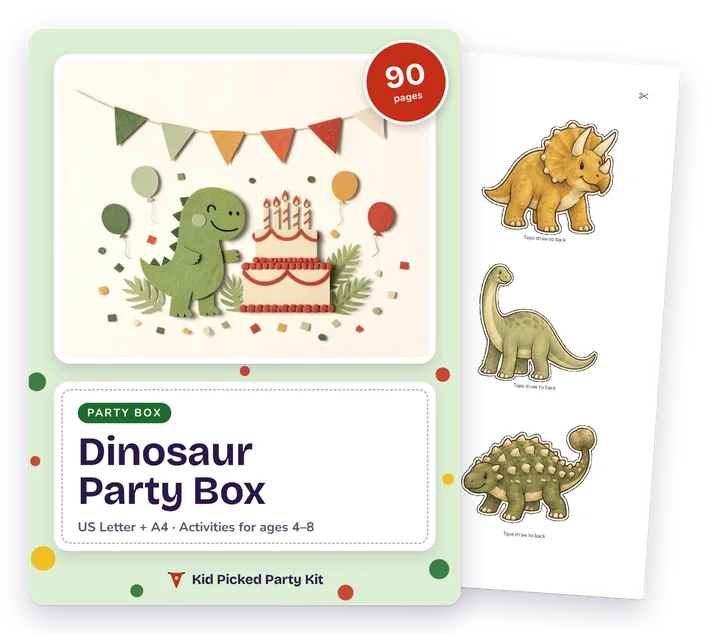
The Dinosaur Birthday Party Box is everything paper for a dinosaur birthday party at home: invite the guests, decorate the table and run the games and a scavenger hunt in one theme. It includes 10 party activities: picture bingo, memory match, I-spy count, maze, word search, pin game, act-it-out cards, would-you-rather cards, roll-and-draw, guess-how-many. It includes a dinosaur scavenger hunt: 24 indoor and 8 yard clue cards, start and finish letters, hiding-order sheet. It includes a host guide with answer keys, start-here guide and how-to-print note. It includes a Party Maker file: type the child's name, age and party details once. It lets you type the child's name, age and party details once in the included Party Maker and print, or fill the blank PDFs by pen. It requires a printer, paper or cardstock, scissors, tape, string, and a web browser to personalize. It comes as separate PDFs on US Letter and A4. It is print-only. It asks for adult help on the cutting and the reading, and the games are written for ages 4–8.
Questions
What games can we play at a birthday party?
Use the table on this page. Join-in rows fit a 3-year milestone, spoken-rule rows fit a 4-year milestone, and turn-taking rows fit a 5-year milestone. Host add-ons such as hot potato, rug spots, and a picture hunt sit in the same table.
What are some fun party games that don't require props?
Use the rows whose prep column says none: big and small, red light green light, follow the leader, hide and seek, tag, Simon Says, I Spy, and quiet statues.
What are some fun team games for a birthday party?
Split the guests into two teams of mixed ages and run a relay: each child carries a balloon or beanbag to a chair and back, then tags the next teammate; the first team to finish all its runs wins that round. For the youngest guests, keep whole-group games such as freeze dance or follow the leader, where nobody is out.
What are some fun birthday party activities for toddlers?
Use the 3-year join-in rows: name and roll, picture match, count the steps, big and small, a pretend visit, and outside choice. An adult stays in the game. Most children (75% or more) notice other children and join them to play by 3 years, on the CDC milestones by 3 years.
How to keep guests entertained at a party?
Open two stations before the first game ends, and switch the whole-group game after a short stretch. By 5 years, most children pay attention for 5 to 10 minutes during activities such as story time or crafts, on the CDC milestones by 5 years.
What are some simple games for kids?
Start with freeze dance, red light green light, Simon Says, or I Spy. Each one starts with one spoken rule and uses nothing you have to buy.