Outdoor scavenger hunt for kids: three routes
Published 2026-10-16 · Updated 2026-10-16
An outdoor scavenger hunt for kids is one of three routes. Use a picture find-list for a preschooler who is not reading, a yard clue trail when you want cards that lead to a prize, or a neighborhood list for a walk on your own block. A scavenger hunt in nature is the find-list. A plan for a fun scavenger hunt in your area is the neighborhood walk.
Three outdoor routes
| Route | Who it fits | What you need | How it ends |
|---|---|---|---|
| Nature find-list | A preschooler who is not reading, including a toddler you name items for | Paper, a crayon, pictures, and a place with sky and plants | Color each find. Leave living things where they are. |
| Yard clue trail | A child who can follow one place at a time. You read the card if the child is not reading yet. | A few cards, yard places you have, and a small prize | The last card names the prize. |
| Neighborhood walk | A walk on your own block, with an adult beside the children | A list of things you can see from the sidewalk | Check off what you pass. |
The Discover the Forest page gives an outdoor hunt a time of 5-25 min, and it names park, yard, garden, forest, and neighborhood as places to do it. A find-list can fit that walk. A yard clue trail is only as long as the places you have.
Nature find-list for non-readers
An outdoor scavenger hunt for preschoolers is this picture list, not a riddle trail. By 3 years, most children (75% or more) draw a circle when you show them how, and talk with you in conversation using at least two back-and-forth exchanges, on the CDC milestones by 3 years. You name the item. The child finds it and colors the picture.
By 4 years, most children (75% or more) say sentences with four or more words and tell what comes next in a well-known story, on the CDC milestones by 4 years. A spoken line such as "cloud, then the leaf" matches that shape.
Draw these, one picture each. Color the picture when the child finds it.
- A cloud.
- A green leaf on the ground.
- A twig.
- A smooth rock.
- A rough rock.
- Grass.
- A flower you look at and leave growing.
- Something yellow.
- A bird.
- Something that makes a sound, such as a bird call or the wind.
- Something soft, such as moss.
- Something round.
- A seed or a pinecone, if your trees have one.
- Your shadow.
The Doing Good Together page says that for very young kids, fill in the blank boxes with items you think they will enjoy finding. The Doing Good Together printable says to color in the picture or draw what you found, and to leave these treasures where you found them. That printable's prompts include a bug, a flower, a nest, animal tracks (a box to draw them), a pinecone, a fallen branch, a worm, a bird, three kinds of trees, water, a seed, three kinds of rocks, and a squirrel. The Doing Good Together printable has no riddle card (Doing Good Together printable).
The Crafts on Sea printable is a color-in find-list that names a butterfly, a flower, a leaf, a snail, a flowerpot, a ladybug, a watering can, a cloud, a twig, a bee, an ant, a stone, a worm, and grass. That page also has a bonus hunt for something soft, hard, spikey, shiny, round and smelly, and it says younger kids can look for the images that they recognise.
An empty egg carton gives each find its own cup, which is the holding method on the Jessica Etcetera page. A younger child can ride while older children look. Her page's nature list starts with a twig, a smooth rock, a bumpy rock, a flower, dirt, a green leaf, an acorn, and clover.
For a scavenger hunt in the woods, keep the picture list and add a fallen branch, moss on a rock, bark from two trees, a seed or pinecone, and animal tracks if you see them. If the canopy hides the sky, swap the cloud for a bird call.
Yard clue trail
A yard clue trail is a different game. Each card names the next place. The child goes there, finds the next card, and continues until a small prize. It is not a checklist of leaves and clouds.
Places that often work: a tree, a hose, a step, a gate, a flowerpot, a bench. Write one card per place you actually have. Hide the card that names the next place at the place before it. The last card names the prize by the door. You read the card aloud, and a picture of the place sits beside the words, for a child who is not reading yet.
Wording by room and by reading level is on scavenger hunt clues. If the yard trail is the birthday activity, teams, hiding order, and the prize rule are on birthday scavenger hunt.
Neighborhood walk on your block
To plan a fun scavenger hunt in your area, walk the block you already know. An adult stays with the children. The list uses things you can see from the sidewalk.
- A stop sign.
- A mailbox.
- A bike.
- A dog on a walk.
- Something red.
- A yellow house, or a yellow flower in a yard.
- A bird.
- A porch.
- A garden hose.
- A tree in a front yard.
- A letter on a street sign, for a child who is reading.
- A parked car in a color you named before you left.
The Jessica Etcetera neighborhood hunt is an I-spy walk, and that page's list includes a stop sign, a mailbox, and 3 birds.
Fit the list to your place
The Doing Good Together page says to modify the list to fit your scene, including a park, a nature center, woods, a seashore, or a backyard. Cross off a pinecone line if your block has no pines, and add a thing you can see from the door. Do this before you hand the list to the child.
The limit of these three routes is the place you are standing in. A nature line fails where that thing does not grow. A neighborhood list only works on a route an adult walks with the children. A yard clue trail only uses places where you can hide a card.
One Saturday outside (illustrative)
A four-year-old colors the cloud, the leaf, and the rock in the yard. An older sibling who reads follows four cards: tree, hose, step, door. A snack waits at the door. If the yard has no hose, the tree card names the step, and the step card still names the door. A toddler on the same morning points when you say "cloud," and you color that one picture.
A printed yard riddle hunt
The cards below are riddles that name the next place. They are not the nature find-list on this page.
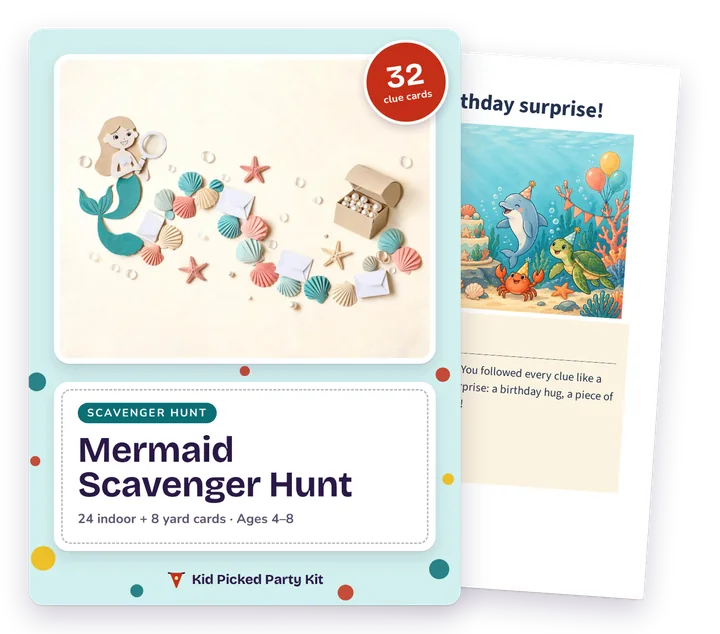
The Mermaid Birthday Scavenger Hunt runs a mermaid treasure hunt at home or in the yard that ends at a surprise, for a birthday child or a party group. It includes 24 indoor and 8 yard riddle cards with picture hints and parent stubs, along with start and finish letters, a hiding-order sheet and blank cards, plus a Party Maker file: pick your places, edit any riddle, add the child's name. It lets you untick places you do not have, then edit riddles and add the child's name in the Party Maker, or use the PDFs and the hiding-order sheet by pen. It includes team mode for two teams as well. It requires a printer, paper, scissors, a small prize, and a web browser to pick places. It comes on US Letter and A4 paper, as two separate PDFs. It is print-only. It is written for ages 4–8, so non-readers need a reading buddy.
Questions
What are some ideas for a nature scavenger hunt for toddlers?
Name one picture at a time, let the child point to it, and color the picture. Start with a cloud, a leaf on the ground, and a rock. Keep the child where you can see them.
What are some ideas for a scavenger hunt in the woods?
Use the picture list on this page, and add a fallen branch, moss on a rock, tree bark, a seed or pinecone, and animal tracks if you see them. Leave each find where it is.
What is a nature scavenger hunt?
A nature scavenger hunt is a find-list of things already outside, such as a cloud, a leaf, a rock, or a bird. It is a different game from a trail of riddle cards.
How to create a nature scavenger hunt?
Draw one picture per item, walk the place once, and cross off any item that is not there. Color each find as you go.
What are some ideas for outdoor scavenger hunts?
A picture find-list, a yard clue trail, and a neighborhood walk. The table at the top says who each route fits and what you need to bring.
What are some good clues for an outdoor scavenger hunt for kids?
On a find-list, the clue is the picture. On a yard trail, one card names one place, such as the tree or the hose. Wording by reading level is on the clues guide.